
- Target participants: Undergraduate, graduate, and postgraduate students.
- Participation format: Participation must be in teams; individual applications are not allowed.
- Team size: Each team must consist of exactly 5 members.
- Academic disciplines: Each team must represent at least 3 different academic disciplines.
- Educational institutions: Each team must represent at least 2 higher education institutions.
- Location: The competition is international, and students from anywhere in the world can participate.
- Competition duration: The competition runs from the application stage in August 2026 through the final presentation and awards ceremony in May 2027.
- Application period: August 3 to October 4, 2026.
- Teams accepted: 90 teams will be accepted into the first stage.
- Stage 2: October 19 to December 6, 2026, with 30 teams advancing.
- Stage 3: January 4 to February 21, 2027, with 15 semifinalist teams advancing.
- Stage 4: March 15 to May 16, 2027, with 5 finalist teams advancing.
- Final presentation: Scheduled for May 21, 2027.
- Funding: The total cash prize pool is US$65,000.
- Application fee: There is no application fee. However, participants are responsible for any costs they incur in preparing and presenting their proposed solution.
- Application process: Teams submit a joint application containing information about all team members, along with responses to questions concerning the problem, solution, impact, innovation, and action plan.
- Information required from team members: Legal name, preferred name, email address, country of citizenship, current country of residence, college or university, academic major, degree type, student status, expected graduation date, and a profile photo.
- Project requirements: The team must propose a product or service that addresses a complex problem, with circular design being a distinctive and essential component of the solution.
- Intellectual property: Teams retain ownership of their solutions and all work submitted. The competition does not take ownership of the project's intellectual property.
- Language requirements: The published eligibility requirements do not specify a particular language requirement or language certificate. However, applicants must prepare written responses in the language required by the application form.
- Main application questions: The problem, the system and factors affecting it, the scope of intervention, the proposed solution, innovation, impact on the Sustainable Development Goals, the role of stakeholders and mentors/experts, and next steps.
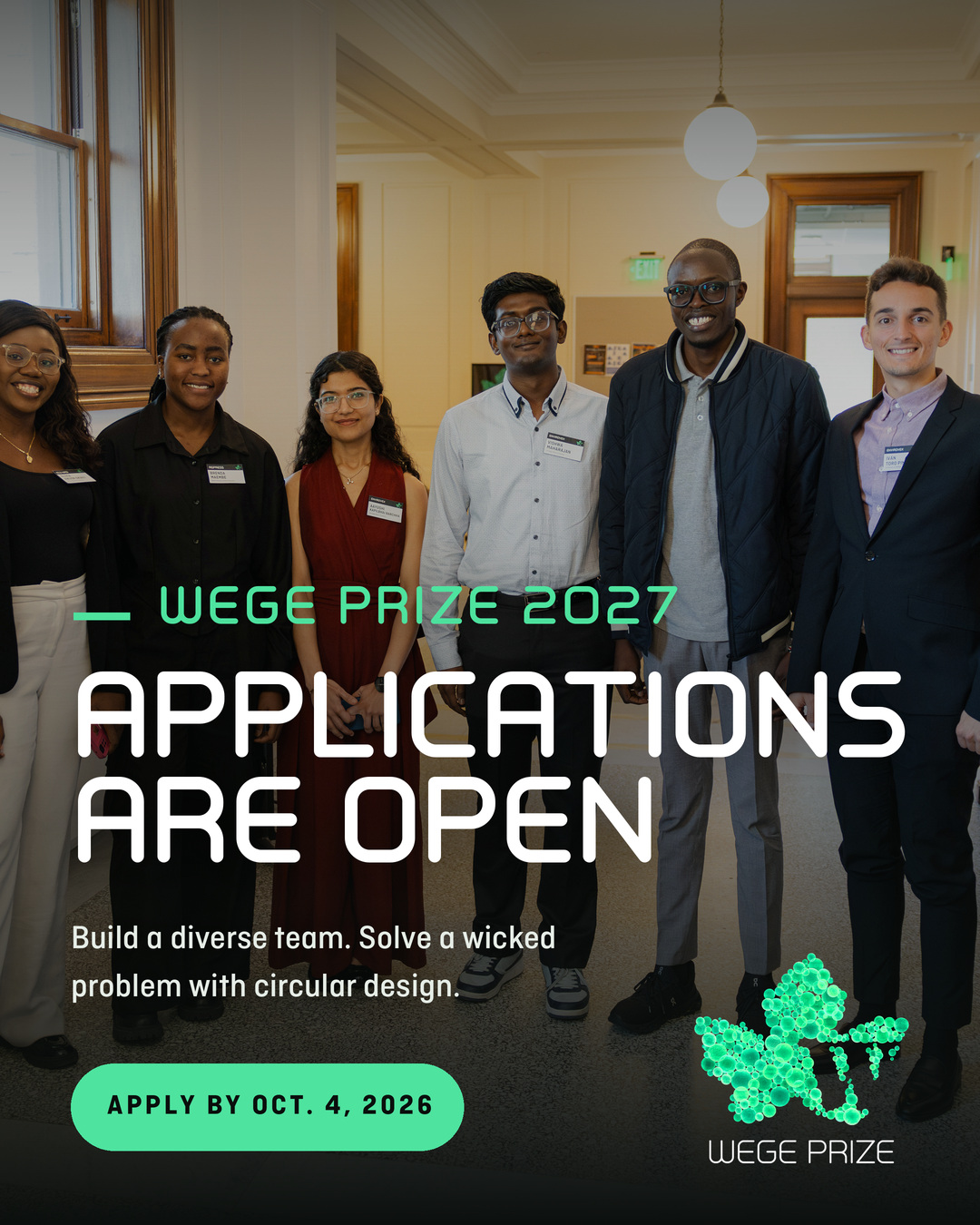
Publish Date
9/9/2026
Application Deadline
10/4/2026
Opportunity Type
Competitions
Publisher
Foras Khadra
Available Countries
All World, The Arab World, Palestine, Jordan, Syria, Lebanon, Iraq, Saudi Arabia, Kuwait, Qatar, Bahrain, United Arab Emirates, Oman, Yemen, Egypt, Sudan, Libya, Tunisia, Algeria, Morocco, Mauritania, Djibouti, Somalia, Comoros
Description
The Wege Prize is an international design competition and global learning laboratory organized by the Wege Center for Sustainable Design at Kendall College of Art and Design, Ferris State University, with support from the Wege Foundation. The competition is aimed at multidisciplinary teams of university students and challenges them to develop realistic solutions to complex and difficult problems using circular economy principles.
Teams are required to design a product or service that addresses a real-world problem, with circular design serving as an essential element of the solution. Throughout the competition, teams develop and refine their ideas through research, experimentation, and direct feedback from judges and experts.
Details
Eligibility Criteria
- Applicants must be members of a team; individual applications are not permitted.
- Each team must consist of exactly 5 members.
- Each team must represent at least 3 different academic disciplines.
- Each team must represent at least 2 different higher education institutions.
- Every team member must currently be enrolled in an undergraduate, graduate, or postgraduate program at a college, university, or equivalent higher education institution.
- Students at different academic levels may be part of the same team, including bachelor's, master's, and doctoral students.
- Students must be enrolled full-time, or the equivalent, for most of the competition period.
- If a student is scheduled to graduate before May 2027, they must remain enrolled as a student until at least December 6, 2026.
- Students from any country worldwide may participate.
- The published eligibility requirements do not specify a minimum or maximum age.
- No specific university major is required; instead, the team must demonstrate academic diversity.
- There is no application fee.
- Teams must continue to meet the team requirements throughout the competition. Any team or individual who fails to meet the eligibility requirements at any stage may be disqualified.
Opportunity Benefits
- Total prize pool: US$65,000.
- First place: US$30,000.
- Second place: US$20,000.
- Third place: US$10,000.
- Two finalist awards: US$2,500 for each team.
- For teams that are not affiliated with a commercial entity, the cash prize is divided equally among the five team members.
- Participants gain an educational and developmental experience by working on a complex real-world problem.
- Teams receive direct and detailed feedback from competition judges throughout the different stages to help them improve their solutions.
- Participants have the opportunity to collaborate with people from different academic disciplines and benefit from diverse perspectives.
- Teams can develop their ideas from an initial concept into a more mature solution through research, experimentation, and evaluation.
- Each finalist team can receive up to US$3,000 to offset travel expenses.
- Hotel accommodation in downtown Grand Rapids is provided for the team member presenting the final presentation and at least one additional team member.
- Not all team members are required to attend the final event.
- Teams retain their intellectual property rights to the solutions they develop during the competition.
- The competition provides opportunities to build a professional network with students, experts, judges, and specialists in circular economy, sustainability, and innovation.